Wednesday, 13 March 2013

Arts Centre, Christchurch

Yesterday, I proudly showed you my stone carving creation that I did whilst working at the Arts Centre. Today I will introduce you to the sight. I know I should have done this the other way round, but hey, I am breaking with tradition. 

Image courtesy of the Arts Centre 

This is the campus circa 1940, when the University of Canterbury still occupied the site. 

Severely damaged in the Feb 2011 quake, the site now has a repair budget of just under $300m. 


All of the above images are courtesy to the Arts Centre

It is a palimpsest of architectural styles that all hark back to the Gothic Revival. The first building to be constructed on site was the Clock Tower in 1877 and modifications and additions continued well into the 1960s. 

Google images 

At the moment, the interior clock mechanism and face have been removed and it is covered in scaffold. 


It was originally built for the first Canterbury College, later the University of Canterbury, before its move to Ilam in the 1970s. Parts of the site were also used as a boys and girls high school (these were, naturally, at opposite ends of the campus; boys to the bottom left and girls to the top right of the site image). 

Some of the most famous students include Ernest Rutherford, aka "Father of the Atom"; Helen Connon, the first Canterbury women to graduate with a BA, and Sir Apirana Ngata, NZ's first Maori graduate.

Benjamin Woolfield Mountfort was the appointed architect for the earliest parts of the campus. Arriving from England in 1850 at the age of 25, he was highly influenced by Pugin's notions of gothic architecture. Consequently, Mountfort's designs for the college were high victorian gothic, using Port Hills basalt for the main structure and Oamaru limestone for the decorative elements. 

The Great Hall was formerly opened in 1882 and for anyone from the UK (i.e. me) it brings forth nostalgia for the Oxbridge cities. 

Google Images 

Currently the tower has been removed to the level of the guttering on the great hall, and at the moment quake strengthening is being undertaken by adding concrete and steel pins through the buttresses and roof. 


It continues in the gothic style of the Clock Tower, but at the same time incorporates aspects of early french gothic design. The most notable of this is the tower currently sitting on the pavement of Rolleston Ave. 

So far I have only been here for a few weeks, but it is an amazingly quirky site and I feel privileged to be able to participate in its conservation and repair. 

I know this is a very brief introduction, but honestly, I could be here for days. However, I will keep you updated on the progress as it moves along and you can also see daily updates here. 


Tuesday, 12 March 2013

Stone Carving

So, I have made it to Christchurch in one piece after travelling round NZ on a bus with some excellent people.


Last week I started work with the Arts Centre (there will be more on this, promise). But, just quickly.....yesterday they let me in the stone carving tent for the afternoon to work with Jeff (one of 7 stonemasons), after a while he let me have my own go at carving a piece of string course. This is the end result.........


Tadaaaaaa!!!  

Okay, so it's not the smoothest (or straightest) string course that ever existed, however, as it is my first attempt I am very proud of my little creation and consequently it sits beside me on the floor at my desk (well for now any way).

Wednesday, 9 January 2013

Melbourne's Golden Mile Heritage Trail


Happy New Year to you all!! Apologies for my silence. So my time in Melbourne is nearly over and I have been meaning to do this walk since I arrived three weeks ago. Today, while my friend Fran, was at work I finally got up off the sofa and walked Melbourne's Golden Mile Heritage Trail. 


Starting off at Melbourne's Immigration Museum, it takes you on, what I presume is a mile walk, through the city to all it's best heritage buildings and architecture.


Melbourne is a beautiful city, full of a range of architectural styles from purely English designs on the neo-Gothic style through to European neo-Classical forms that also incorporate Australian features. 

Allow me to show you a few of my favourites: 


The York Butter factory is located on the corner of King Street and Collins Street and was originally constructed as two individual warehouses (seen above), built in 1854 and 1855. In 1902 the buildings were combined and converted into the butter factory we see today by Hansel and Farrell. 


The Mitre Taven was established in 1867, though it is thought that parts of the building date to the 1850s. The architecture is distinctly English with no concessions made at all for the Australian climate; the steeply pitched roof is still waiting for the snow that will never come and the rain that comes in short, sharp, infrequent bursts. The tiny windows are a nod to the 'window tax' issues belonging to the homeland, but which did not exist in the new world, and the gables and glass work are typical of contemporary English Inns.


This piece of spectacular architectural construction was originally the English, Scottish and Australian Bank and Stock Exchange Building, it is now a Bank Museum for ANZ. It was erected in 1883/87 as the head office and manager's residence and was designed by William Wardell. It's secular neo-gothic architecture is the finest in Victoria. If you do wander past this building, please, please, please poke your head round the door. The interior is s.t.u.n.n.i.n.g! 


As I carried on up Collin's street there are many arcades to be marveled at, and the shops inside are almost as impressive as the architecture above. 


Finally, when your feet begin to tire and your thoughts are beginning to turn to one of the many lovely little coffee shops that Melbourne is full of, you reach the Royal Exhibition Building surrounded by the beautiful Carlton Gardens. 


It was constructed in 1880-1 for the Melbourne International Exhibition. As a 'Palace of Industry', it displayed the technologies and achievements of the mechanized age. It was designed by Joseph Reed, built by David Mitchell and was the greatest show the city had ever seen, attracting over one million visitors. In 2004 the building and the surrounding gardens were inscribed on UNESCO's World Heritage List of the 'Convention concerning the Protection of the World Cultural and Natural Heritage'. 

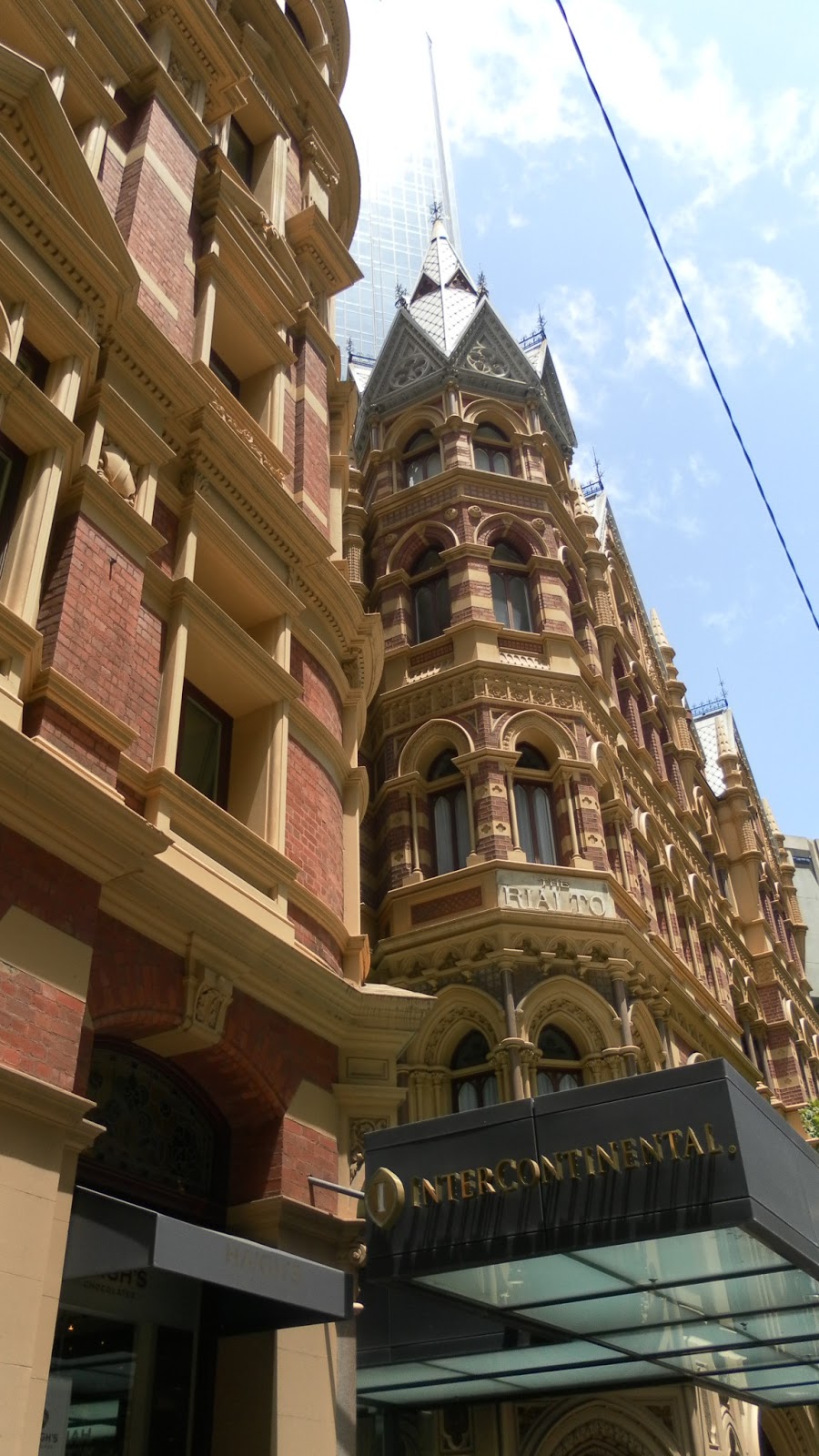
Here are a few more that caught my eye....


The Golden Mile Heritage Trail is a great way to explore the city and find places that you would otherwise ignore and carry on past. If you are anything like me, you will spend most of the trail with your head craned back and staring towards the stars, just be careful not to walk into people, you get some very strange looks. 

Tours depart daily at 10am from Federation Square and cost $20. There are even small plaques and discs on the pavement to guide your way through if you choose not to take the guided tour (though I did not realise this until I had nearly reached the final building and instead spent the whole tour squinting at my teeny tiny map....). 

Have fun and get exploring!