Tuesday, 16 April 2013

The rain has finally arrived .....

It has been an absolutely awful day in Christchurch, I don't think it has stopped raining since I woke up this morning.Though, to be honest, this is the first decent amount of rain we have had since I arrived on the South Island in January! 

Work at the Arts Centre, however, has been good. After a very interesting meeting with the heritage people from NZHPT and Christchurch Council (where after weeks of structural engineering meetings it was nice to actually understand what was under discussion), I got to wander around the site snapping up-to-date site images for our CEO: 


We have three main buildings that are under going work at the moment;the Clock Tower and College Hall, Gymnasium and Registry. 

Registry is nearly finished and will hopefully be let come summer (our winter, but to avoid confusion for those in the Northern Hemisphere). 


 (Do not believe the scaffold...it lies!)


A few weeks ago, the replicas of the chimney that were carved on site of those that fell down in the earthquake were reinstalled on the northern facade. 


and the stonemasons have also finished the southern window and quoins.


The College Hall and Clock Tower however, have quite a long way to go: 


(In this case, the scaffold is definitely not lying.)

 The internal walls and mezzanine of the Gymnasium have come down and the internal wall strengthening is starting to be installed.

 Most of it is through the use of reinforced concrete and steel pins, which at the moment, look slightly threatening.


Work is also about to begin on Boys' High. Internal pinning of the gable ends has already taken place. 


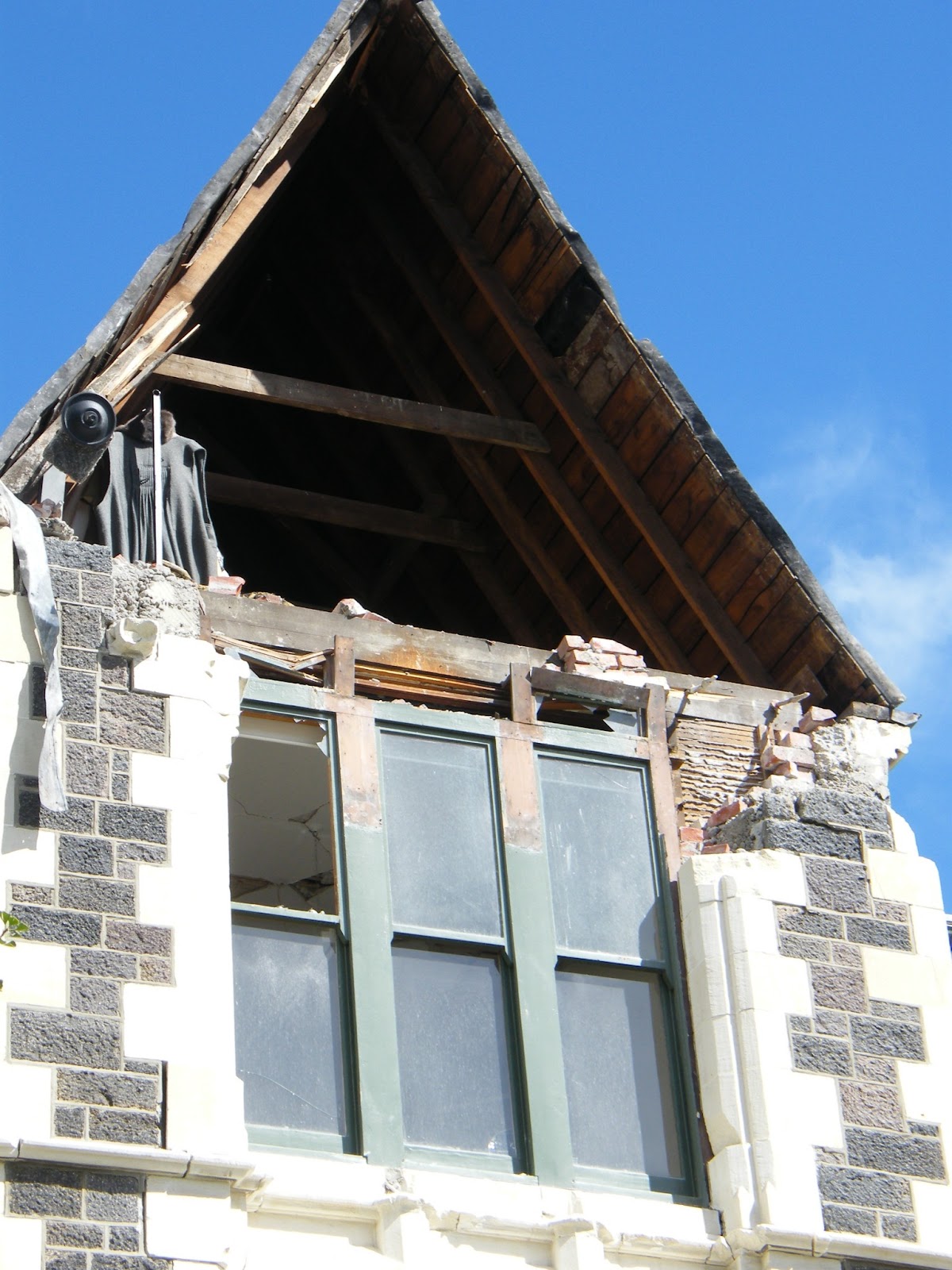
But this image shows just how much two buildings can move. Quite a significant amount of the damage actually came from either additions or extensions that were not incorporated into the original building effectively or through adjacent structures: as the seismic activity causes movement, the individual areas move seperatley, causing force and friction and inevitably resulting in a rather large (unfortunate) mess of masonry. 

Yes, that is daylight through there! 

This is a very brief outline of the current work at the Arts Centre, if you have any questions please feel free to ask either here or on our tumblr account


However, I wouldn't want you thinking that it is work, work, work around here: 


Hope you are enjoying the rain just as much as we are!

Tuesday, 19 March 2013

Gables, Diamonds and Staples

One of the projects I have been helping out with so far is the repair of the gable ends- there are quite a few! Unfortunately, many of them did not survive the three major quakes (Sept 10, Feb 11 and July 11) overly well. 


As the majority of the Arts Center is listed as Category I (i.e. it has outstanding national value - for the British, it is equivalent to our Grade I) in order to retain the original facade and, consequently authenticity, those stones that can be replaced in their original setting, will be. 

To do this, the stonemasons give each individual gable end a code and then as the stones are taken down each one gets an individual number:  


For example, CB3 would be the Clock Tower, gable 3 and AA2 is the Boys' high, gable 2. 

Then, when the stones are taken down, each number is written on the reverse of the respective stone and then stored on a palate.  They have a particular area the numbers have to be written on so that 6 does not become 9, etc. 


The numbers are then carved into the stone with a (very scary) cylindrical Dremel drill that is coated in diamond dust so it can with stand the strength of the original stone (basalt or bluestone, see previous post). 

Now, this drill, can drill. I was honestly scared for my fingers! It is also incredibly easy to break; the slightest bit of pressure in the wrong place and the diamond dusted bit goes flying - eye protection is a must! - unfortunately I managed to do this on my first go, but it was fixable so I was forgiven. 

After the number is carved out, it is then painted over so it can withstand the elements and be easily seen. 


Yes, that is me with my very fetching hard hat and high vis.


The palates are then stored until it is time for the stones to be replaced in-situ. In order to quake strengthen them the stones are being "stapled" to both themselves and the roof structure, so that if there is another quake they will not break forward. Hopefully. 


All of the images are courtesy of the Arts Center!


Wednesday, 13 March 2013

Arts Centre, Christchurch

Yesterday, I proudly showed you my stone carving creation that I did whilst working at the Arts Centre. Today I will introduce you to the sight. I know I should have done this the other way round, but hey, I am breaking with tradition. 

Image courtesy of the Arts Centre 

This is the campus circa 1940, when the University of Canterbury still occupied the site. 

Severely damaged in the Feb 2011 quake, the site now has a repair budget of just under $300m. 


All of the above images are courtesy to the Arts Centre

It is a palimpsest of architectural styles that all hark back to the Gothic Revival. The first building to be constructed on site was the Clock Tower in 1877 and modifications and additions continued well into the 1960s. 

Google images 

At the moment, the interior clock mechanism and face have been removed and it is covered in scaffold. 


It was originally built for the first Canterbury College, later the University of Canterbury, before its move to Ilam in the 1970s. Parts of the site were also used as a boys and girls high school (these were, naturally, at opposite ends of the campus; boys to the bottom left and girls to the top right of the site image). 

Some of the most famous students include Ernest Rutherford, aka "Father of the Atom"; Helen Connon, the first Canterbury women to graduate with a BA, and Sir Apirana Ngata, NZ's first Maori graduate.

Benjamin Woolfield Mountfort was the appointed architect for the earliest parts of the campus. Arriving from England in 1850 at the age of 25, he was highly influenced by Pugin's notions of gothic architecture. Consequently, Mountfort's designs for the college were high victorian gothic, using Port Hills basalt for the main structure and Oamaru limestone for the decorative elements. 

The Great Hall was formerly opened in 1882 and for anyone from the UK (i.e. me) it brings forth nostalgia for the Oxbridge cities. 

Google Images 

Currently the tower has been removed to the level of the guttering on the great hall, and at the moment quake strengthening is being undertaken by adding concrete and steel pins through the buttresses and roof. 


It continues in the gothic style of the Clock Tower, but at the same time incorporates aspects of early french gothic design. The most notable of this is the tower currently sitting on the pavement of Rolleston Ave. 

So far I have only been here for a few weeks, but it is an amazingly quirky site and I feel privileged to be able to participate in its conservation and repair. 

I know this is a very brief introduction, but honestly, I could be here for days. However, I will keep you updated on the progress as it moves along and you can also see daily updates here